We’ve launched a new web portal! Visit findhistory.nd.gov to search our collections.
Due to a road closure, the Killdeer Mountain Battlefield State Historic Site
is temporarily closed.


United States Army Occupation (August 8, 1872 ‑ April 16, 1894)
Camp Hancock was the location of an infantry post from 1872 to 1877 and a quartermaster depot and signal office from 1877 to 1894. The post was originally named Camp Greeley in 1872 in honor of Horace Greeley, editor of the New York Times, liberal candidate for the presidency, and author of the saying "Go west, young man." On October 7, 1873, the post was renamed Camp Hancock after the commander of the Department of Dakota, Winfield Scott Hancock.
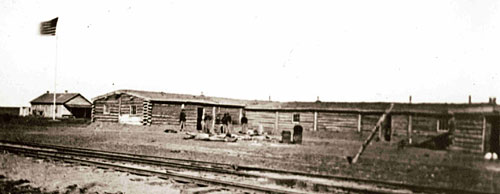
The purpose of the post was to protect supplies, equipment, and engineering crews of the Northern Pacific Railroad, as well as the citizens of Edwinton, which was renamed Bismarck in July 1873. By 1883 the post was also serving as a storage station for the U.S. Army quartermaster's supplies, which would be shipped, by rail, wagon, or steamboat, to posts along the river and farther west.
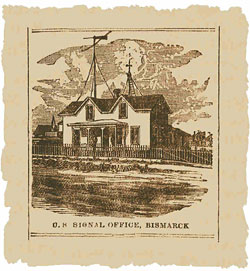
A Signal Corps "reporting station" was established at Camp Hancock in 1874. The primary mission of the Signal Corps was to transmit military messages; they also maintained records of the nation's weather patterns. With the fighting between the plains tribes and the military, for the most part under control, the last of the front‑line troops were withdrawn from Camp Hancock on April 12, 1877. The post continued to function as a quartermaster's depot and signal station, which required only a small staff of technical specialists.
Sketch of Signal Service Office
located at 213 First street.
Bismarck Tribune, May 7, 1880.
Address:
101 East Main Ave.
Bismarck, ND 58501
Get Directions
Hours:
Site grounds with outdoor interpretive signs are open year round.
Buildings are open for events, school tours, rentals, and by appointment.
Contact Camp Hancock:
phone: 701.328.9528
email: [email protected]
Contact SHSND:
phone: 701.328.2666
email: [email protected]